The Making of Lynetteholm: Step Foot on Denmark's Newest Landmass
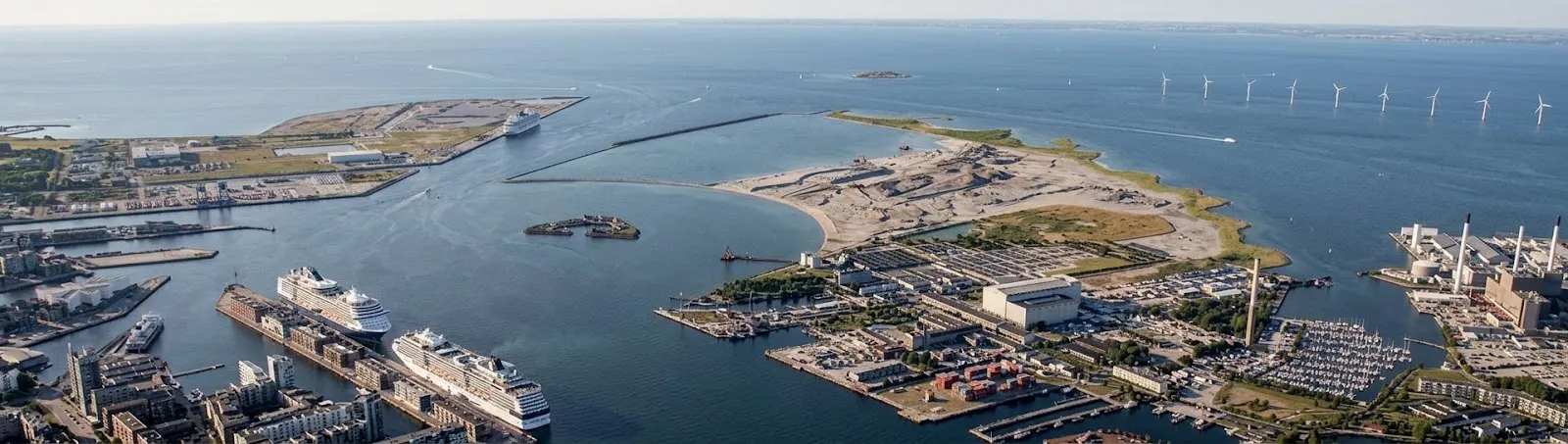
Introduction to a Historic Megaproject Copenhagen is a city in constant change. From the historic bridge districts to the modern architecture in Nordhavn and Ørestad, the Danish capital has always managed to reinvent itself. But no project in recent Danish history is as ambitious, debated, and geographically transformative as Lynetteholm. The new artificial peninsula, which is currently rising from the seabed in the Øresund strait between Nordhavn and Refshaleøen, is not just an expansion of the city's area; it is a multifunctional answer to two of the capital's biggest challenges: future climate change and a housing shortage.
This megaproject will literally redraw the map of Copenhagen. When Lynetteholm is fully completed, it will cover an area of approximately 2.8 square kilometers – corresponding to roughly 400 football pitches. This makes it the largest land reclamation in Copenhagen in recent times, and the project will span several decades before the final resident can move in.
The Vision: Coastal Protection and Urban Development Hand in Hand The idea for Lynetteholm was presented at a large-scale press conference in 2018. The vision behind the project rests on two main pillars:
Firstly, Lynetteholm is to function as a massive climate shield. As global temperatures rise, Copenhagen is threatened by sea-level rises and severe storm surges. Throughout history, the city has been vulnerable to the forces of water, but with the construction of Lynetteholm, a dam and an advanced coastal landscape will be created to protect the central and low-lying parts of the capital against flooding.
Secondly, Lynetteholm is to be a new, vibrant district. Copenhagen is experiencing significant population growth, and there is a great need for new housing to stabilize property prices and ensure space for the city's expansion. The plan is for the artificial peninsula to house around 35,000 residents and offer an equivalent number of workplaces. The district is envisioned as a sustainable oasis with a strong focus on public transport and cycling rather than private car use.
Construction: How Do You Build a Peninsula? Building a landmass of this caliber requires enormous engineering ingenuity. The construction of Lynetteholm is fundamentally divided into phases. First and foremost, the very outline of the peninsula is established – the so-called perimeter. This is done by building stone dams and driving sheet piles into the sea.
Once the outline is in place, the enormous "bathtub" that has been created in the middle must be filled. This is one of the most ingenious, but also drawn-out, parts of the project. The fill consists of surplus soil from construction projects throughout Copenhagen and the surrounding area. Every year, millions of tons of surplus soil are produced when excavating for new metro stations, basements, and foundations. Instead of transporting the soil far away, it is now being used as the foundation for Denmark's new landmass.
Natural Coast and Biodiversity Facing the Øresund strait, a so-called "natural coast" is being established. Instead of the classic, hard concrete edges that characterize many of Copenhagen's inner harbor channels, Lynetteholm's eastern coastline will be constructed as a soft landscape with stone reefs and shallow-water areas. This design is not only aesthetically pleasing; it is intended to break the force of storm waves while simultaneously creating new habitats for marine flora and fauna. The vision is to improve biodiversity in a part of Øresund that has long been dominated by industry.
Infrastructure: Eastern Ring Road and New Metro An entirely new district of this size requires massive infrastructure to prevent the city's traffic from collapsing. Therefore, Lynetteholm is inextricably linked to two other major infrastructure projects:
New Metro: It is an integral part of the plan that Lynetteholm will be served by the metro. A new line (M5) is set to connect the peninsula with the rest of the city, ensuring a fast, green form of transport for future residents.
Eastern Ring Road: To divert heavy traffic around the city center, an eastern ring road (a harbor tunnel) is planned. The road will run from Nordhavn via Lynetteholm to Amager, which will relieve routes such as Knippelsbro and Langebro.
Criticism, Debate, and Environmental Concerns Although the ambitions are high, Lynetteholm has certainly not been without opposition. The project has sparked extensive debate and numerous demonstrations. The criticism has been multifaceted, but environmental movements, in particular, have sounded the alarm.
One of the early major controversies involved the dumping of sea sludge. To make room for the perimeter embankments, the seabed was excavated, and the often polluted sludge was to be dumped in Køge Bay. Following massive public and political opposition, as well as criticism from our neighbors in Sweden, this practice was halted.
Additionally, there has been sharp criticism of the construction phase itself. The transport of the many millions of tons of surplus soil requires up to a hundred trucks a day, shuttling back and forth through the city's streets for decades. This has created great fear of noise and air pollution. Finally, several experts point to the economic risks; according to critics, the construction act was rushed through without sufficient preliminary studies of the project's true costs.
A Project for Future Generations The timeline for Lynetteholm testifies to its monumental scale. The reception of soil is expected to continue all the way into the 2050s. The first construction projects are planned to begin sometime in the late 2030s, as the soil settles and the infrastructure is established.
Today, Lynetteholm is no longer just a colored drawing. Machines are working at full capacity, and the first loads of soil have been put in place. It is a fascinating process to witness the Copenhagen of the future taking shape. Whether one is a supporter or a strong critic, the project is a defining chapter in Denmark's history – concrete proof of human ability and the will to expand horizons and build new land from scratch.